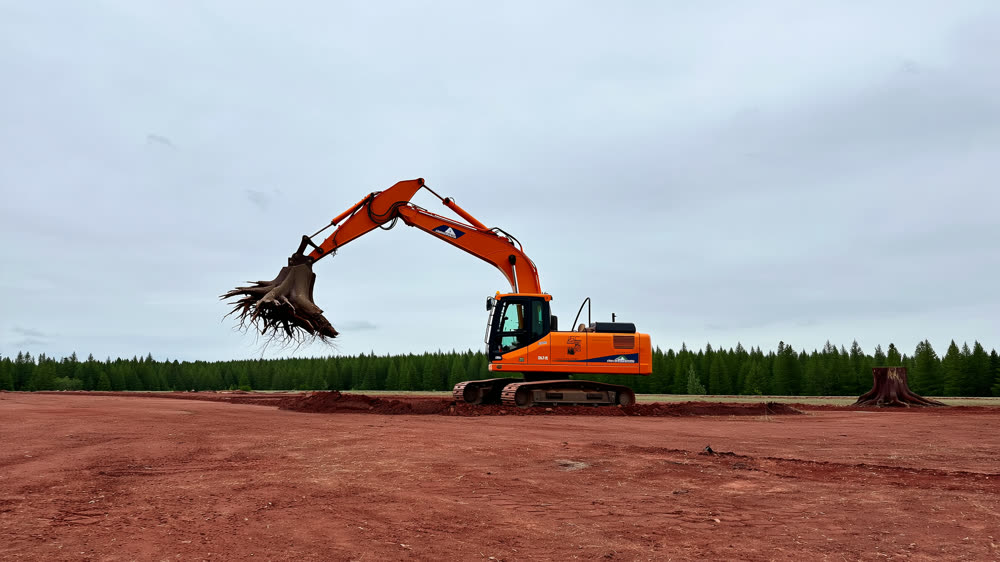
Illustration, not a photo of the crew.
Grading turns a cleared lot into a buildable one. Rough grading cuts the high spots and fills the low ones to set a pad for a house, shop, shed or driveway; finish grading dresses the ground around it so water runs to the street or a swale, not the foundation. Seed and straw cover the clay before the next hard rain.
It pairs naturally with lot clearing: the machines are already on site, the stumps are out and the grade can be set while the ground is open. Grading to a stamped plan, tested structural fill and septic work stay with the builder's own contractors.
What a grading and site prep job involves
- Walk the lot, mark pad corners, the drive line and where water should leave
- Silt fence, ditch checks and a stone entrance set where the permit calls for them
- Rough grade: cut and fill moved to set pad and drive heights
- Finish grade: ground sloped off the pad and raked smooth, rock and roots picked
- Seed and straw put down, final walk with you or the builder
What's included
- Site visit and a written price before any work
- Rough and finish grading of the quoted area
- Pad and drive shaped to the heights agreed on the walk
- Seed and straw on the disturbed ground
Not in the price
- Engineered or compacted structural fill with testing, which the builder's engineer specifies
- Trucked-in fill dirt, topsoil and driveway stone beyond the quoted loads
- Permit fees, surveys and stamped grading plans
Grading Piedmont clay
Below the topsoil, most Upstate lots are the red Piedmont clay that soil surveys call the Cecil type: it drains well once in place but turns sticky and plastic when wet. Graded wet, it smears and ruts, so the crew waits out a rainy week rather than push mud.
Grading counts as land disturbance by the county's own definition. In unincorporated Spartanburg County and in Lyman, Wellford, Duncan, Inman and Cowpens, a house lot under an acre goes through the less-than-one-acre permit, work within fifty feet of a creek, wetland or floodplain goes to County Engineering first, and anything over an acre needs state NPDES coverage. The City of Spartanburg and the other towns run their own review.
Grading and Site Prep pricing in Spartanburg
A shed or small driveway pad on nearly level ground typically runs $800 to $2,000 in 2026; rough and finish grading of a house site with a drive runs about $2,500 to $7,000; seed and straw adds roughly $500 to $1,200 an acre. These are typical Upstate ranges, not quotes. What moves the number: dirt trucked in or hauled out, slope, rock, wet weather and how much erosion control the permit asks for.
The firm number comes from the crew after a site visit.
Full price list and what moves the price →
Related: Land Clearing Permits and Burning Rules in Spartanburg County, Land clearing in Boiling Springs, Land clearing in Inman. Official page: Spartanburg County Building Codes.
Grading and Site Prep questions, answered
What is the difference between rough grading and finish grading?
Rough grading moves the bulk of the dirt to set pad, drive and yard heights. Finish grading is the last few inches: smoothing, sloping off the foundation and picking rock so seed has a clean bed.
How much should the ground slope away from a new house in Spartanburg County?
A common residential-code rule is about six inches of fall in the first ten feet, and the crew grades to that unless your builder or engineer says otherwise. On a tight lot a swale carries the water around.
Can the grading be done the same week the lot is cleared?
Usually, if the permit is in hand and the ground is dry. The county treats clearing ahead of grading as disturbance anyway, so plan both under one permit.
Does grading fix a yard that stays wet after rain?
When the cause is a low spot or ground tilted toward the house, yes. Water from a spring or a seeping hillside needs more than grading, and the crew will say so on the walk.